Barcelona's levers bought time. The stadium bought the recovery
Published
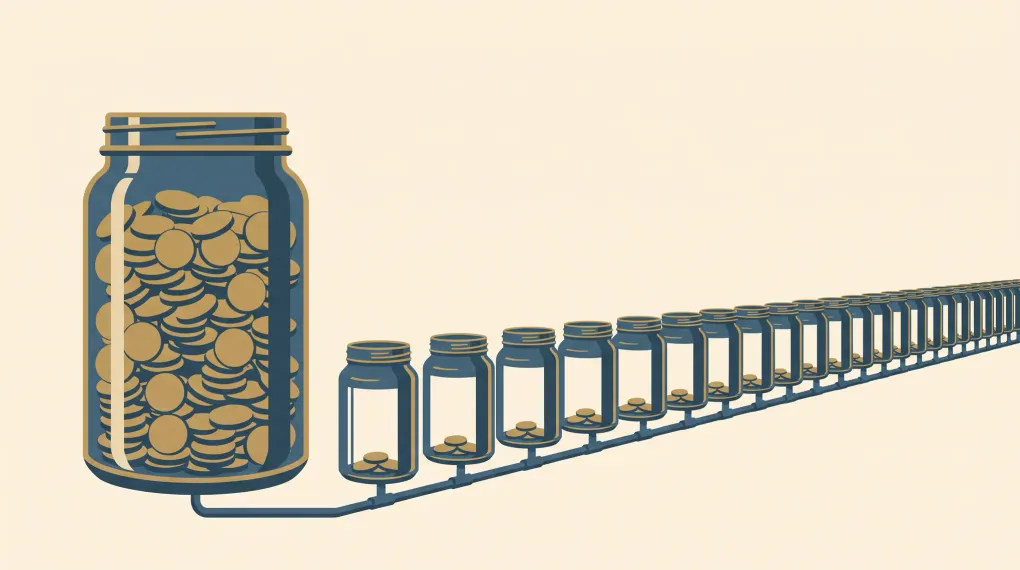
In short: between 2021 and 2023 Barcelona sold a quarter of its LaLiga television money for twenty-five years, plus half of its media company, raising roughly €1.1 billion and turning a €377m pre-tax loss into a €423m profit. Those were the palancas, the levers. They were designed to lift the club’s squad cost limit so it could register players. Today that limit stands at €582.769m, up 65.9% in about a year — and the driver is not the levers, whose effect has been fading. It is the return to the Camp Nou.
Our explanation of LaLiga’s squad cost limit covers the mechanics: the limit is checked before a player is registered, so a club that exceeds it cannot field the player at all. That is the rule that produced the Dani Olmo saga.
This piece is about the other half of the problem. Once you understand that the limit binds, the interesting question is how a club raises it. Barcelona spent four years answering that question in the most aggressive way European football has seen.
What a lever actually is
A palanca is not a loan, and that distinction is the whole point.
A loan adds debt to the balance sheet, and debt service is a cost that reduces the squad cost limit. What Barcelona did instead was sell future revenue outright. The buyer pays a lump sum today; the club books it as income now; and the revenue stream itself belongs to the buyer for decades.
Booking it as income is what matters. The squad cost limit is derived from projected revenue minus the costs that are not squad costs. Convert twenty-five years of future television money into one year’s recognised income and the limit moves — immediately, and by a lot.
The four levers
| Lever | What was sold | Raised |
|---|---|---|
| 2021/22 | 10% of LaLiga TV rights, 25 years, to Sixth Street | €266m |
| 2022/23 | A further 15% of LaLiga TV rights, to Sixth Street | ~€400m |
| 2022/23 | 49% of Barça Studios / Barça Vision | ~€200m |
| 2022/23 | Revaluation of the retained 51% at the sale price | €208m |
The first two together transferred 25% of the club’s LaLiga television income for 25 years for about €665m.
The fourth line is the one worth pausing on. Nothing was sold. Having agreed a price for 49% of the media company, Barcelona restated the 51% it still owned at the same implied valuation and booked the increase as profit. That is permitted accounting. It is also a €208m gain that generated no cash whatsoever.
Across two seasons the levers produced close to €1.1 billion. The Swiss Ramble’s reconstruction of the accounts puts the effect plainly: without them, 2022/23 would have been a €377m pre-tax loss instead of the reported €423m profit.
What it bought, and what it cost
It bought registrations. Players were signed, registered and played, and the club stayed in the competition at the level its squad implied.
The bill arrives every year until roughly 2047. The television sales commit Barcelona to paying Sixth Street about €41m a year for 25 years — more than €1bn over the life of the deal, against €665m received.
And that annual payment lands in exactly the wrong place. It is a cost that sits between revenue and the squad cost limit, so every year from now to 2047 the club’s headroom is smaller than it would have been. The lever raised the limit once and lowered it slightly forever after.
There is a second, subtler cost. A lever can only be pulled once per asset. Having sold 25% of the television money, Barcelona cannot sell it again. The instrument that solved the 2022 problem is unavailable for the next one.
The limit since then
| Date | Barcelona’s squad cost limit |
|---|---|
| September 2025 | €351.284m |
| February 2026 | €432.807m |
| 2026/27, after the summer window | €582.769m |
That is +€231.485m, or 65.9%, in roughly a year. For comparison, Real Madrid’s 2026/27 limit is €832.786m, about €71m up on the €761.226m it held in 2025/26 — a 9% rise from a much higher base. The full club-by-club figures for the previous season are on our squad cost limit data page.
Here is the part that gets reported backwards. That 66% rise is not the levers working. The levers’ contribution has been decaying — a one-off gain recognised in 2022/23 does less for the limit with every year that passes from it.
What changed is duller and far more important: the club got its stadium back. Returning to the Camp Nou restored matchday income, a revenue line that had been largely absent during the rebuild, and it is recurring. Alongside it, the extended Spotify agreements — reported as running to 2030 for the shirt and 2034 for the stadium name — gave the revenue projection something stable to rest on.
Why this is the whole argument in one club
Every cost control in European football is a percentage of revenue. We have made that point about UEFA’s 70% rule and the Premier League’s squad cost ratio. It follows that there are only two ways to raise your ceiling: increase revenue, or change when revenue is recognised.
Barcelona did both, in that order — and only one of them worked twice.
The levers were the second kind. They moved income from the future into the present, which raised the limit in the year it was needed and reduced it in every year afterwards. They were not fraudulent, not hidden, and not obviously wrong for a club facing an immediate registration crisis. They were a way of borrowing headroom from a club that did not yet exist.
The recovery, when it came, was the first kind: a stadium full of people paying to be there.
That is not a moral about prudence. It is a structural fact about how these rules work. A percentage-of-revenue cap can always be gamed at the margin by accelerating recognition, and clubs under pressure will do it — but the gaming is self-limiting, because each asset can only be sold once and the payments last decades. Sooner or later the limit converges on what the club actually earns.
Barcelona has spent four years proving it.
Sources
- Squad Cost Limit (Límite de Coste de Plantilla Deportiva)LaLiga
- Barcelona Finances 2022/23The Swiss Ramble
- Barcelona gets bigger spending cap, opens door on new signingsESPN
- Barcelona agree 10% sale of LaLiga TV rights to ease financial troublesESPN
- Barcelona's squad cost limit rises to €582.769mSempre Barça