Do football's financial rules entrench the clubs on top?
Published

In short: the charge against cost controls is that they let rich clubs stay rich and stop anyone else catching up. The academic evidence half-supports it. But the rules that actually entrench the hierarchy are not the cost rules at all — they are the ones that decide who gets the money in the first place, and €853 million of the Champions League pot is allocated on what clubs achieved in previous seasons.
Every argument about football’s financial rules eventually arrives at the same accusation: that they are a ladder pulled up behind the last clubs to climb it.
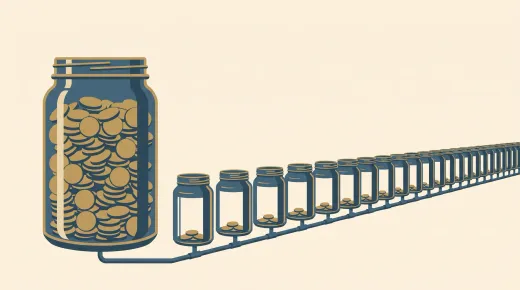
It is worth taking seriously, because the mechanism is easy to state. UEFA caps squad spending at 70% of revenue; the Premier League at 85%. A percentage is neutral in form. Applied to unequal revenues it produces unequal permissions, and it forbids the one manoeuvre that historically let a club jump the queue — spending far beyond its income for a few years until the spending created the income.
So: is the accusation true?
What the evidence actually shows
Researchers have measured this rather than asserted it. The clearest study compares competitive balance across the big five leagues in two windows — 2005/06 to 2010/11 against 2011/12 to 2016/17, either side of Financial Fair Play’s introduction — using standard concentration and dominance indices.
The result is genuinely mixed. There was a statistically significant decline in competitive balance after FFP in Spain, Germany and France, but not in England or Italy.
That is a weaker finding than either side usually claims. Something happened in three of five leagues, and the three where it happened are the three with the most lopsided revenue distributions to begin with — which is a clue about cause rather than proof.
Look at who won last season and the accusation gains force:
| League | 2025/26 champion | Titles |
|---|---|---|
| LaLiga | Barcelona | 29th |
| Premier League | Arsenal | 14th English title |
| Serie A | Inter | 21st |
| Bundesliga | Bayern Munich | 34th |
| Ligue 1 | Paris Saint-Germain | 14th |
Not one outsider. The Champions League went to PSG, with Arsenal beaten in the final.
Arsenal is the interesting entry. Their title was the first in over two decades, so it counts as change — but Arsenal are a founding member of the English elite who had been temporarily displaced, not an insurgent. The churn happens inside the established set, not into it.
The case against the accusation
Three things complicate the story, and an honest account has to carry them.
Clubs do still break through. Bayer Leverkusen won the Bundesliga in 2023/24, ending eleven consecutive Bayern titles. Napoli won Serie A in 2022/23, their first since 1990. Girona finished third in LaLiga and reached the Champions League. Atalanta won a European trophy. None of that is supposed to be possible under a frozen hierarchy.
The counterfactual was worse for small clubs, not better. The unregulated era did not produce social mobility; it produced insolvencies. Parma, Portsmouth, Leeds, Rangers — the clubs destroyed by unrestrained spending were rarely the giants. A rule that stops a club spending itself out of existence protects the vulnerable more than the secure.
Cost rules are not why Bayern win. Bayern won the Bundesliga repeatedly before FFP existed and would keep winning if it were repealed tomorrow. German football’s concentration is a product of how Bundesliga money is divided and how big Bayern’s domestic market is. The cost rule arrived long after the imbalance did.
That last point is the door into what is actually going on.
The entrenchment engine is on the revenue side
Cost rules limit what a club may spend as a share of what it earns. They say nothing about how much it earns. And European football’s revenue distribution contains a mechanism that pays clubs, directly and explicitly, for having been successful in the past.
In 2024/25 UEFA distributed roughly €2.032 billion to Champions League clubs. That divides into a participation fee — €18.62m each, identical for all 36 — performance bonuses for results in the competition, knockout progression payments, and the value pillar.
The value pillar is €853 million, and it is allocated according to broadcast market share and each club’s ten-year and five-year UEFA coefficient.
Read that again. Roughly 42% of the largest prize pool in club football is handed out on the basis of results in previous seasons and the size of the club’s domestic television market. Neither of those is something this year’s team can affect.
A club that has been in the Champions League for a decade collects a large coefficient share, which raises its revenue, which raises its permitted squad spending under the 70% rule, which raises its chance of qualifying again. A club arriving for the first time collects the participation fee and very little else.
That is a compounding loop, and it is entirely separate from cost control.
What the cost rules actually do
Set against that, the honest verdict on the squad cost ratio is narrower than the accusation and less innocent than the defence.
The cost rules did not build the hierarchy. Broadcast money, coefficient payments and domestic market size built it, over thirty years.
But they do two things that keep it in place. A ratio applied to a skewed input returns a skewed output — 70% of a very large number is a very large number, and the rule multiplies the existing gap rather than narrowing it. And they close the historical escape route. Blackburn in 1995, Chelsea after 2003, Manchester City after 2008 all reached the top by spending far beyond their revenue, funded by an owner, for years. That is now precisely what is prohibited.
You can think the prohibition is right — those were destabilising, and two of the three required a benefactor whose money came from somewhere the club could not question. But its effect on mobility is not ambiguous. The route existed, it was used, and it is closed.
What would change it, and why it won’t
If the diagnosis is revenue rather than cost, the remedy is redistribution rather than caps. Compress the coefficient share. Enlarge the equal participation payment. Reduce the multiple between the top and bottom of domestic broadcast deals.
Football has already shown what happens when that is proposed. In November 2025, Premier League clubs voted on anchoring — tying every club’s maximum spend to a multiple of what the lowest-earning club receives centrally. It was the one proposal on the table that would have compressed the hierarchy rather than preserved it in proportion.
It failed. The Squad Cost Ratio, which locks in proportionality, passed the same day with exactly the fourteen votes needed.
That is the whole argument in one meeting. Given a choice between a rule that limits spending relative to your own revenue and a rule that limits it relative to the poorest club’s revenue, the clubs with the most revenue chose the first.
Not because cost control is a conspiracy. Because a system in which the biggest beneficiaries hold the votes will keep choosing rules that protect what they already have — and cost rules do exactly that while looking, on their face, like restraint.
Sources
- The unintended consequence of Financial Fair Play: an examination of competitive balance across five European football leaguesSheffield Hallam University (Plumley, Ramchandani & Wilson)
- A review of competitive balance in European football leagues before and after Financial Fair Play regulationsSustainability (MDPI)
- Distribution to clubs from the UEFA Champions League, UEFA Europa League and UEFA Europa Conference League 2024/25 to 2026/27 (Circular 13/2024)UEFA
- UEFA Financial Report 2024/25UEFA
- PSG received €144m for winning the 2024-25 Champions LeagueESPN